The first thing you notice is the quiet. Not the quiet of peace — there is no peace in Gaza. But the quiet of the sea, which doesn't give a damn about bombs or blockades. It just keeps rolling in, wave after wave, indifferent to the hell on shore.
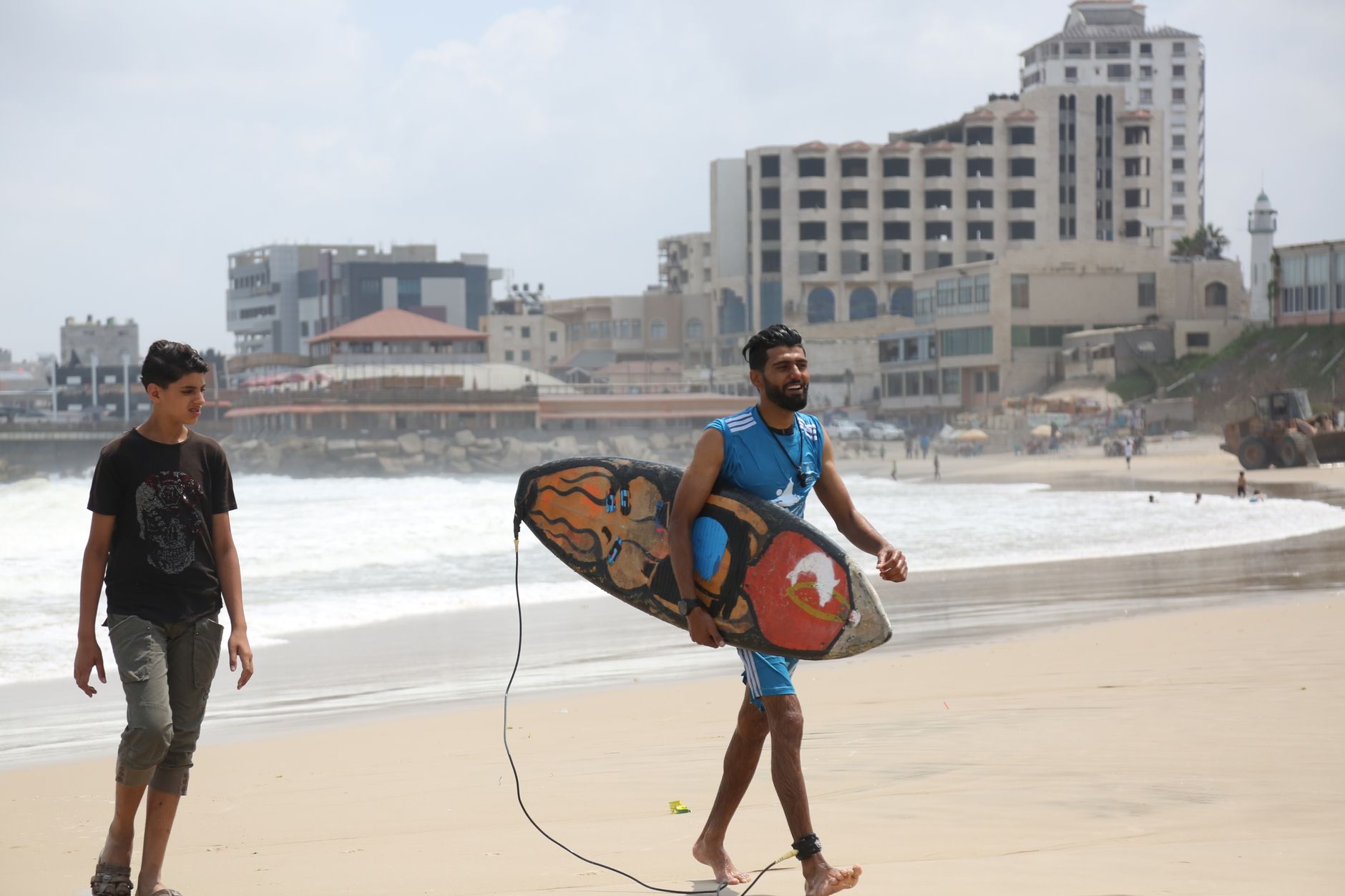
I met Ahmed at dawn on a beach that used to be packed with cafes and kids. Now it's a graveyard of concrete and rusted metal. He was waxing a surfboard that looked older than him, patched with duct tape and sheer will. His hands shook, but he smiled when he saw me.
"The sea is the only thing that hasn't left us," he said. "Even when they bomb the water, the waves come back."
Ahmed is part of Gaza's surf community — or what's left of it. Before the war, there were maybe 200 surfers along this strip of coast. Now? He counts fewer than 20. The rest are dead, displaced, or have lost their boards to shrapnel and fire.
The board that survived a missile
I asked Ahmed about his board. He laughed — a short, bitter sound. "This board? It was my cousin's. He was killed in December. The board was in his house when a missile hit. I found it under rubble. The stringer was cracked, so I fixed it with fishing wire."
He pointed to the repair. It looked like a scar. "Every time I ride, I feel him with me."
The Israeli military has targeted beaches repeatedly. In October, a strike hit a group of fishermen. In November, a surf competition — a small, hopeful event — was canceled after shells landed offshore. The surfers say the army uses drones to harass them. "They buzz over our heads like mosquitoes," Ahmed said. "Sometimes they drop sound bombs near us. But we don't stop."
Why? That's the question I kept asking. Why surf when you might die?
Defiance in the face of annihilation
Dr. Laila Mansour, a psychologist at Al-Shifa Hospital (what remains of it), told me: "When you have nothing left, you cling to the small things that make you feel human. For these young men, surfing is that. It's a declaration: 'I am still alive. I can still feel joy.'"
Joy. A strange word in Gaza. But I saw it. I watched Ahmed paddle out through a slick of debris — plastic bottles, a child's shoe, something that might have been a piece of a drone. He caught a small wave, maybe three feet high. For three seconds, he was free. The war didn't exist. Neither did the blockade, the hunger, the grief.
Then he wiped out. Came up coughing saltwater. And laughed again.
"They can take our homes, our families, our future. But they can't take the sea. And as long as the sea is here, we will ride it." — Ahmed, Gaza surfer
I met another surfer, Youssef, who lost his leg in an airstrike. He was learning to surf on a board with a modified grip. "I'm slower now," he said. "But I still catch waves. The sea doesn't care if you have one leg or two. It just lifts you up."
The surf community has become a kind of family. They share boards, wetsuits (most are torn and patched), and food when they have it. They teach each other. They mourn together. "When one of us dies, we paddle out and scatter flowers on the water," Ahmed said. "It's our funeral."
The silence of the international community
You'd think the world would notice. A story of resilience, of humanity refusing to be erased. But the international community has been deafening in its silence. No surf brands have stepped up to donate equipment. No humanitarian aid for surfers. "We don't matter," Youssef said, without bitterness — just fact. "We're just Palestinians. Our lives are cheap."
But they don't stop. Every morning, before the bombs start falling again, the surfers gather. They check the wind. They argue about swell direction. They paddle out into a sea that could be bombed at any moment.
I asked Ahmed if he was afraid. He looked at me — really looked — and said: "Every day. But fear is a wave. You can't stop it. You have to ride it."
He turned and jogged toward the water, his board under his arm. I watched him paddle out, a tiny figure against the vast, indifferent sea. For a moment, I forgot the war. I just saw a man surfing.
Maybe that's the point. In a world that wants to destroy them, these surfers are saying: You can kill us, but you cannot make us stop living. Not today. Not on this wave.