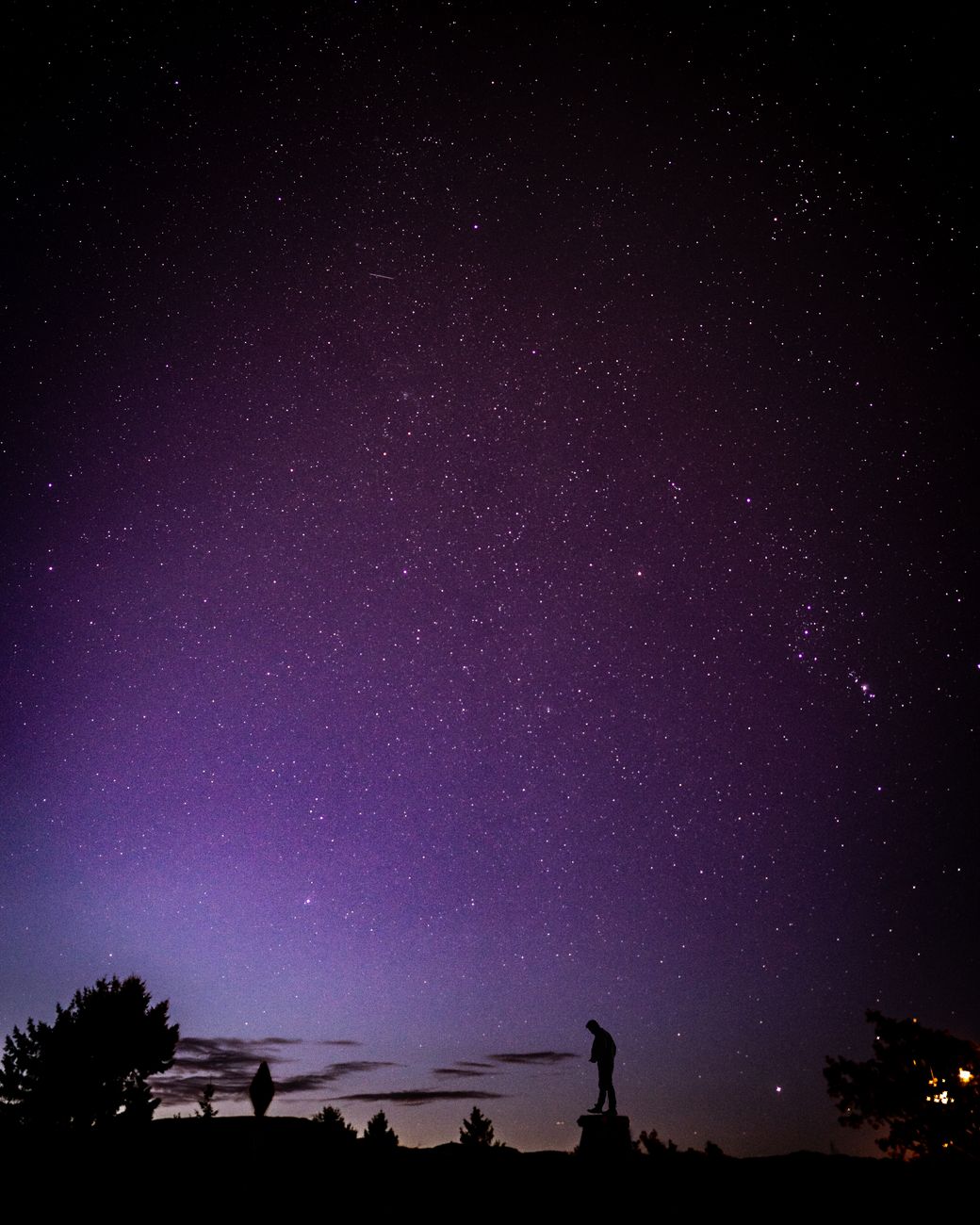
Some of us play games to escape. Others play them to steal ideas. I’m in the second camp.
Back in 2014, I sank 200 hours into Dragon Age: Inquisition. I remember the dragons, the politics, the endless fetch quests. But what stuck with me, what kept me up at night even years later, was a dumb little minigame called Astrariums. You traced constellations by connecting stars along a fixed pattern. It was calming, satisfying, and I wanted more. The problem? Once you solved all twelve, that was it. Done.
So I built my own.
Starglyphs is a puzzle game that takes that idea and runs with it — procedurally, infinitely, and with a layer of mathematical rigor that would make Euler proud. It’s live now, a free browser game, and it’s already got people arguing about the best path through a six-pointed star.
From Astrarium to Algorithm
Here’s the core: every puzzle is a map of stars, and you have to trace a path that visits each star exactly once and ends at the start — an Eulerian circuit. In graph theory, that’s a path that uses every edge exactly once. In practical terms, it’s a puzzle that feels like a logic grid but looks like a constellation.
I’m a hobbyist developer, not a mathematician. I had to teach myself the basics of cycle detection and backtracking algorithms. The first version crashed on the third puzzle. The second one generated unsolvable mazes. The third one worked, but it was boring: every puzzle looked the same.
The breakthrough came when I realized the shape of the puzzle matters. Not just the graph, but the visual layout. I want players to look at a cluster of stars and immediately see a bear, a swan, a sword. That’s the magic of constellations — our brains are hardwired to pattern-match. So I built a shape library, then an algorithm that draws random points, connects them without crossing lines, and checks for that elusive Eulerian property.
Why This Matters Beyond Gaming
Let me get a little pretentious for a second. Euler paths are everywhere. They’re the reason delivery routes get optimized, the reason you can walk across a city without retracing steps, the reason Konigsberg’s bridges became a meme in math textbooks. Starglyphs is a toy, sure, but it’s a toy that teaches you something. Every time you solve a puzzle, you’re building intuition for graph theory. You’re learning to see structure in chaos.
That’s more than most AAA games can say. I’m looking at you, Call of Duty.
And the procedural generation means no two puzzles are alike. I’ve been testing it for weeks and still find configurations that surprise me. Sometimes the solution is obvious — you just follow the edge. Other times, you hit a dead end and realize you’ve been fooled by symmetry. It’s the kind of frustration that feels good, like a crossword or a sudoku.
“The first version crashed on the third puzzle. The second generated unsolvable mazes. The third was boring. But I kept going.”
What Players Are Saying
I posted Starglyphs on Hacker News last week. The reaction was… intense. One commenter called it “a meditation on order.” Another asked for a mobile port so they could play on the train. A third argued that the puzzles should have multiple solutions and got into a 50-comment debate about uniqueness in procedural generation.
That’s the thing about puzzle communities: they will fight over rules like theologians. I love it.
The most common complaint is difficulty scaling. Right now, the puzzles start easy and get hard, but there’s no adaptive system. A few players hit a wall and quit. I’m working on a difficulty meter that adjusts based on how fast you solve the previous puzzle. Also, more shapes. Someone requested a cat. I’m on it.
The Bottom Line
Starglyphs isn’t trying to be the next Baldur’s Gate. It’s a small, obsessive project born from a love of one specific, forgotten minigame. It’s free, it’s infinite, and it’s smarter than it has any right to be. If you have ten minutes and a need to trace some stars, go play it. Just don’t blame me when you lose track of time.
I certainly have.