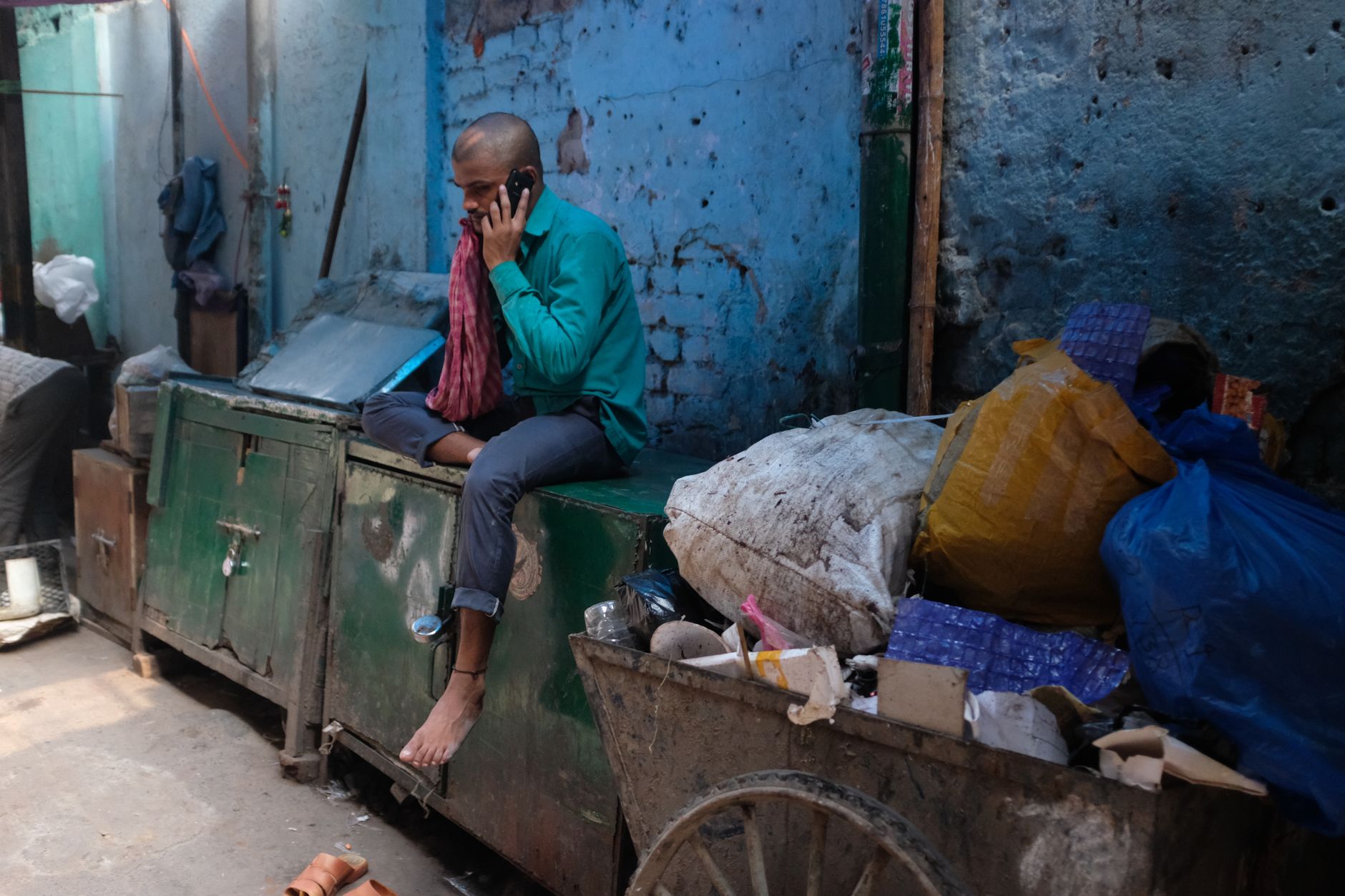
MUMBAI — His hands are a roadmap of scars. Ravi, 24, holds them up in the dim light of a recycling shed. “Daily cuts,” he says. “Chemicals. Infections.” He’s been breaking down old electronics for six years. He doesn’t know what the fumes are. He just knows his head spins and his throat burns.
Ravi is one of India’s estimated 500,000 e-waste workers. They’re the invisible bottom of the world’s digital supply chain. Every smartphone upgrade, every dead laptop, every discarded charger — it all ends up here. In sheds and scrap yards across Delhi, Mumbai, and Bengaluru. Where men, women, and children smash circuit boards with hammers and dip wires in acid baths to get at the copper.
“The companies make billions. We get burns that never heal.” — Ravi, e-waste worker
India generates roughly 3.2 million tonnes of e-waste annually. Only about 30% is formally recycled. The rest goes to the informal sector — unregulated, unmonitored, unprotected. Workers earn 200–300 rupees a day ($2.40–$3.60). They wear no masks, no gloves. The result is a public health crisis hiding in plain sight.
What’s in the smoke?
Circuit boards contain lead, mercury, cadmium, beryllium, brominated flame retardants. When workers burn wires to strip insulation — a common practice — they release toxic fumes. Chronic exposure leads to lung damage, neurological issues, reproductive problems. A 2024 study by the Centre for Science and Environment found that 80% of informal e-waste workers in Delhi have respiratory complaints. Two-thirds report skin infections.
“The level of toxic metals in their blood is two to three times higher than the general population,” says Dr. Sunita Narain, director of the Centre for Science and Environment. “This is not a problem that can be fixed with better masks. It requires a complete overhaul of how we manage electronic waste.”
But overhaul is a big word. India’s E-Waste (Management) Rules exist on paper. They mandate extended producer responsibility — companies should take back old products. Enforcement is laughable. The Central Pollution Control Board has fewer than 50 inspectors for the entire country. Most scrap yards operate without permits. Workers have no legal status, no health coverage, no union.
The global cost of cheap electronics
This is not just India’s problem. It’s the ugly shadow of global consumerism. Every year, the world produces 53 million tonnes of e-waste — enough to cover Manhattan 100 metres deep. Only 17% is formally collected and recycled. The rest gets dumped or handled in places like Ravi’s shed.
International Basel Convention bans the export of hazardous waste from rich to poor countries. But loopholes are big enough to drive a truck through. E-waste gets labelled as “used goods” or “charitable donations” and shipped to destinations like India, Ghana, and Pakistan. A 2023 investigation by the Basel Action Network tracked 300 containers of “reusable” electronics from Europe to India. Half were junk.
“The system is broken,” says Priti Mahesh, a Delhi-based environmental lawyer. “Companies design products for obsolescence. Consumers upgrade every two years. And the cost is externalised to the poorest people on the planet.”
The solution isn’t just better recycling. It’s designing products that last. That are repairable. That can be taken apart. Some countries — France, for example — have introduced “repairability indices” that rate electronics based on how easy they are to fix. The EU’s new Right to Repair rules require manufacturers to make spare parts available for up to 10 years. India has no such laws.
What should change?
First, enforce existing laws. Fine companies whose e-waste ends up in informal yards. Second, formalise the informal sector. Register workers. Provide protective gear and health screening. Third, set up collection systems that actually work. In India, corporate take-back programmes are mostly PR stunts. You can drop off your old phone at a company store — but try doing that in a village 200 km from the nearest city.
Fourth — and this is the hard one — stop making everything disposable. The smartphone industry is the worst offender. Every year, a billion new phones are sold. Average lifespan? Two to three years. Batteries can’t be removed. Screens can’t be replaced. Planned obsolescence is baked into the business model.
“We need to start thinking of electronics not as consumables, but as durable goods,” says Narain. “That shift in mindset is the foundation of everything else.”
Back in the shed, Ravi pulls a gold-plated pin from a circuit board. He'll sell it for a few rupees. He doesn't know where the gold ends up — maybe in a jeweller's shop, maybe in a new phone. “The companies make billions,” he says. “We get burns that never heal.”
He goes back to work. There’s another batch of dead devices waiting. A mountain of them.