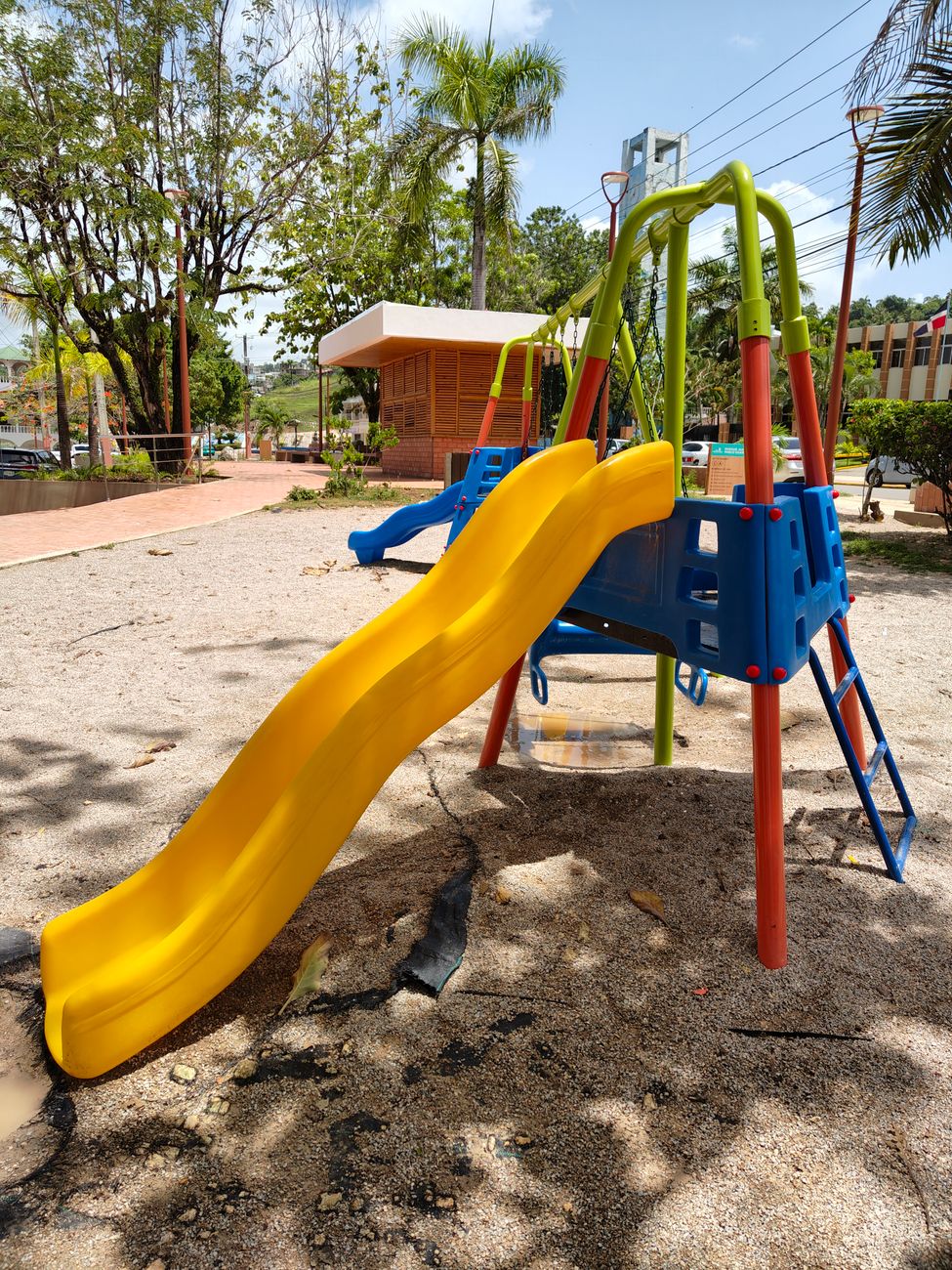
GAZA CITY — The swing set in the Nuseirat camp stands twisted like a broken rib. The slide is shattered, its jagged edge a reminder of the airstrike that turned this playground into a graveyard last spring. No one has pushed a child on a swing here in over a year. No one will.
This is the third summer of war for Gaza’s youngest. And for mothers like Umm Khaled, 34, the toll is not measured in rubble alone. “My son is six. He doesn’t ask for toys anymore. He asks if the bomb will come today,” she tells me, her voice flat, exhausted. “He should be learning to ride a bike. Instead, he learns to hide.”
The numbers are stark. According to the UN’s Office for the Coordination of Humanitarian Affairs, over 600,000 children in Gaza have been displaced multiple times since October 2023. Of those, nearly 17,000 have been killed or injured — a figure that doesn’t capture the invisible wounds: the nightmares, the regressions, the silence where laughter used to be.
Summer, stolen
Before the war, summer in Gaza meant chaos — the good kind. Kids flooded the streets after school let out, chasing soccer balls, splashing in the sea, begging for ice cream from vendors who knew every child’s name. The beach at Deir el-Balah was a carnival of inflatable floats and shrieks of joy. Now, the same shoreline is littered with wreckage. The sea, when it’s safe enough to approach, is a graveyard of fishing boats and memories.
“My daughter used to draw flowers and cats,” says Mona al-Haddad, 29, mother of three. “Now she draws black smoke and bodies. That’s what she sees. That’s what fills her head.” Mona’s youngest, two-year-old Youssef, has never known a world without fighter jets. He doesn’t flinch when the walls shake. He just stares.
“He should be learning to ride a bike. Instead, he learns to hide.” — Umm Khaled, mother of six
The psychological impact is staggering. A July 2026 report by Save the Children found that 96% of Gaza’s children exhibit symptoms of severe trauma — bed-wetting, mutism, aggression. Dr. Rami al-Banna, a pediatric psychiatrist working in a makeshift clinic in Rafah, says the kids he sees have stopped playing altogether. “Play is how children process disaster. When they stop playing, they stop processing. They just survive.”
The burden of breadwinners
But trauma isn’t the only thing stealing childhood. Many of Gaza’s children have become the family’s sole providers. With fathers killed, injured, or trapped in the north, boys as young as nine haul water, scavenge for firewood, and queue for hours under the sun for a single loaf of bread. Girls, some barely into adolescence, cook on open flames, change the bandages of younger siblings, and console mothers who have nothing left to give.
I meet Ahmed, 12, outside a bombed-out bakery in Khan Younis. He’s been here since 5 a.m. It’s now 11. “I take the bread home. My mother is sick. My father is dead,” he says, not meeting my eyes. He does not smile. He does not complain. He speaks like a man twice his age, but his shoulders are still thin as a child’s.
Ahmed’s story is not unusual. UNICEF estimates that over 40% of families in Gaza now depend on income earned by children. That’s not a statistic — it’s a generation being robbed of the one thing they can never get back: time to be young.
Art as resistance, when it dares
In a few corners of Gaza, there are desperate attempts to restore normalcy. A handful of volunteers — teachers, artists, former clowns — run “play sessions” in tent camps. They bring chalk, paper, puppets. The sessions are held in bomb shelters, between shelling. But the children come. For an hour, maybe two, they color outside the lines. They draw houses that still stand. They pretend the sky is blue, not grey with smoke.
“Art is a lifeline,” says Samira al-Atrash, a kindergarten teacher who now runs a session in a tent near Maghazi camp. “When a child draws a tree, they are planting hope. When they laugh, even for a second, they are defying the war.” But she admits the laughter is fleeting. “Yesterday, a boy drew a bird. Then he crossed it out and drew a drone. That’s where we are.”
“When a child draws a tree, they are planting hope. But yesterday, a boy drew a bird, then crossed it out and drew a drone.” — Samira al-Atrash, teacher
These efforts are heroic but microscopic. The UN’s Education Cluster reports that fewer than 5% of Gaza’s children have access to any form of structured play or learning. The rest spend their days in limbo — queuing for aid, picking through rubble, or simply staring at the walls of tents that smell of sewage and despair.
A generation defined by loss
The long-term consequences are terrifying. Developmental psychologists warn that children who experience prolonged toxic stress — the kind that comes from constant violence, displacement, and deprivation — suffer permanent changes to their brain architecture. Their ability to trust, to learn, to form relationships is compromised. They become adults who have never known safety, who expect betrayal, who survive by shutting down.
Gaza is raising a generation of survivors. But survival is not the same as living. And a childhood spent surviving — carrying jerrycans of water instead of backpacks, memorizing the sound of drones instead of multiplication tables — is a childhood that cannot be reclaimed.
As I leave Gaza, I pass a group of children playing in the rubble. They have no toys. They have invented a game: who can dodge the sharpest piece of shrapnel? They laugh when they almost get cut. It’s not joy. It’s a laugh that has learned to live alongside death.
The summer will end. The war may pause. But for Gaza’s children, the clock of childhood stopped ticking long ago. And no ceasefire will ever give them back the years they lost.