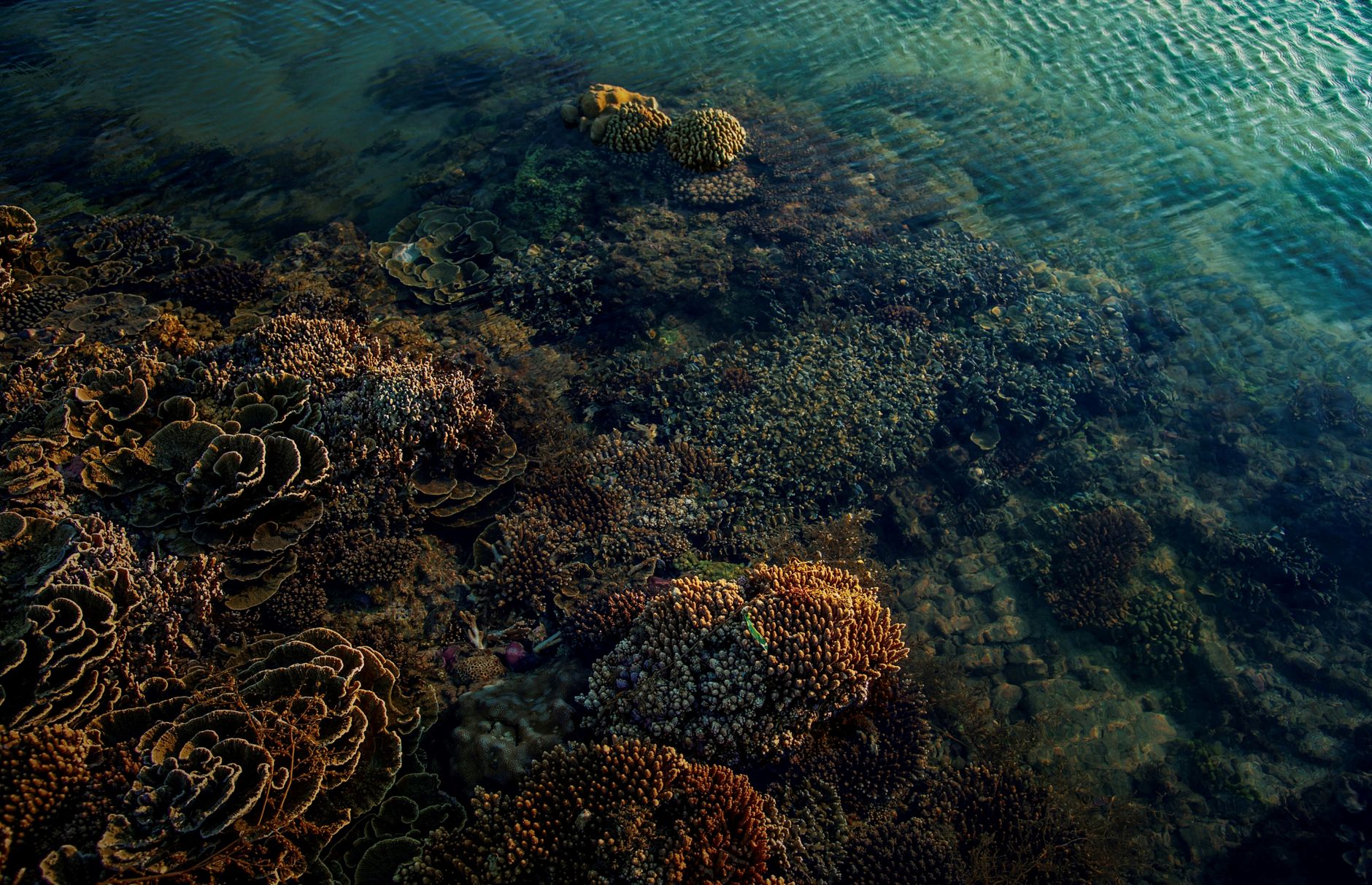
The ocean is cooking. On the Great Barrier Reef, a mass bleaching event this year killed nearly a quarter of the coral. In the Caribbean, staghorn and elkhorn corals have collapsed by over 90% since the 1970s. The obituaries are writing themselves — unless you know where to look.
Because not all corals are dying. Some reefs, scattered across the globe, are surviving in water that should be lethal. They're not just surviving — they're thriving. Scientists call them "coral strongholds." And they might be the last, best hope for the world's reefs.
Going "Coral Hunting"
Marine biologist Dr. Line K. Bay and her team at the Australian Institute of Marine Science have been doing something that sounds like a treasure hunt. They call it "coral hunting." They drop into the Pacific's warmest waters — places where temperatures spike above 89°F — to find corals that haven't bleached.
"We're looking for the survivors," Bay told me. "Corals that have experienced heat stress and come out the other side white, but alive."
These survivors are rare. In some areas, they're one in a thousand. But they hold something precious: genetic and microbial adaptations that allow them to tolerate extreme heat. Bay's team collects fragments, brings them to labs, and stress-tests them in heated tanks. The hardiest ones are then bred in captivity, with the goal of outplanting them onto degraded reefs.
"The goal isn't just to save coral. It's to give evolution a head start."
It's a controversial strategy. Critics call it "gardening" — too small-scale to matter in a global crisis. But Bay pushes back: "We have to try everything. If we can identify and propagate these strongholds, we might buy reefs decades of time."
What Makes a Stronghold?
Not all heat-tolerant corals are created equal. A stronghold is a reef that has survived two or more severe bleaching events without significant die-off. These reefs exist in places like the Red Sea, parts of the Pacific, and — surprisingly — the Persian Gulf, where corals handle summer temperatures that would kill most species nearly anywhere else.
Dr. Emma Camp, a coral researcher at the University of Technology Sydney, has spent years studying these outliers. "In the Persian Gulf, water temperatures can hit 96°F," she says. "And corals there not only survive — they reproduce. That's remarkable."
But the secret isn't just in the coral animal itself. It's in the algae that live inside coral tissues — the zooxanthellae. Some algae strains are more heat-tolerant than others. Camp's research shows that stronghold corals often harbor unique algal communities that can keep photosynthesizing even when water is dangerously warm.
"These are not super-corals," she cautions. "They have limits. But understanding their biology could help us identify which reefs to protect, and which might be lost causes."
The Strategy Debate
The stronghold concept splits the conservation world. On one side: the "protectionists" who argue we should focus on reducing emissions and preserving the most intact reefs. On the other: the "interventionists" who think we must actively engineer coral resilience — through selective breeding, assisted migration, or even genetic modification.
Dr. Terry Hughes, a prominent coral reef scientist, recently called the stronghold approach "a dangerous distraction." In an op-ed published last month, he wrote: "The idea that we can identify a few 'winning' reefs and use them to repopulate the rest of the ocean is magical thinking. The only real solution is to stop burning fossil fuels."
But Bay and Camp argue that even if emissions stopped today, oceans would continue warming for decades. "We are past the point where mitigation alone is enough," Bay says. "We need adaptation strategies. The strongholds are a natural resource we can't afford to ignore."
It's a philosophical divide that mirrors debates in every climate-stressed field: how much do we try to save what's already there, versus how much we try to create something new?
Mapping the Future
In practice, strongholds are being mapped in real time. The nonprofit Coral Reef Alliance has identified 50 potential stronghold reefs across the Indo-Pacific, using satellite data and on-the-ground surveys. Their criteria: low pollution, stable temperature regimes, and a history of surviving bleaching.
"If you look at a map of projected warming, you can see exactly where the refuges will be," says Dr. Helen Fox, the Alliance's science director. "The problem is that many of those places are also under development pressure — from tourism, overfishing, or coastal construction."
So the strongest reefs are not just biological puzzles — they're political battlegrounds. Governments must decide whether to designate them as marine protected areas, restrict fishing, or ban coastal development. In Indonesia, the Raja Ampat islands are a stronghold — but they're also a diving hotspot, and the local economy depends on visitors who trample the same corals they've come to see.
In the Bahamas, a proposed stronghold zone was recently rejected after lobbying from cruise ship companies. The corals there will likely be gone within a decade.
What This Means for You
Why should anyone outside of marine biology care about coral strongholds? Because reefs aren't just pretty vacation spots. They support a quarter of all marine life, protect coastlines from storms, and provide food and income for 500 million people. When reefs die, the ripples reach far inland.
And there's a deeper lesson: resilience matters. In every ecosystem, in every community, some individuals survive what kills others. The question is whether we can learn from them fast enough.
This is not a story of hope, exactly. It's a story of triage. We are now in the era of choosing what to save. And the choice isn't between everything and nothing — it's between something and nothing.
The corals in the Persian Gulf don't know they're exceptional. They just keep growing, cell by cell, under a sun that would kill their cousins a thousand miles away. That stubbornness — that refusal to die — may be the only thing that keeps a few reefs alive until humans figure out how to stop cooking the planet.
Or maybe not. Maybe the strongholds will fail, too, when the next heatwave comes. That's the terror of this moment: we don't know. But we know this: if we don't look for the survivors, we'll never find them.
Somewhere in the Pacific, a coral is growing in water that should be too hot. It's white. It's alive. And it's waiting.


