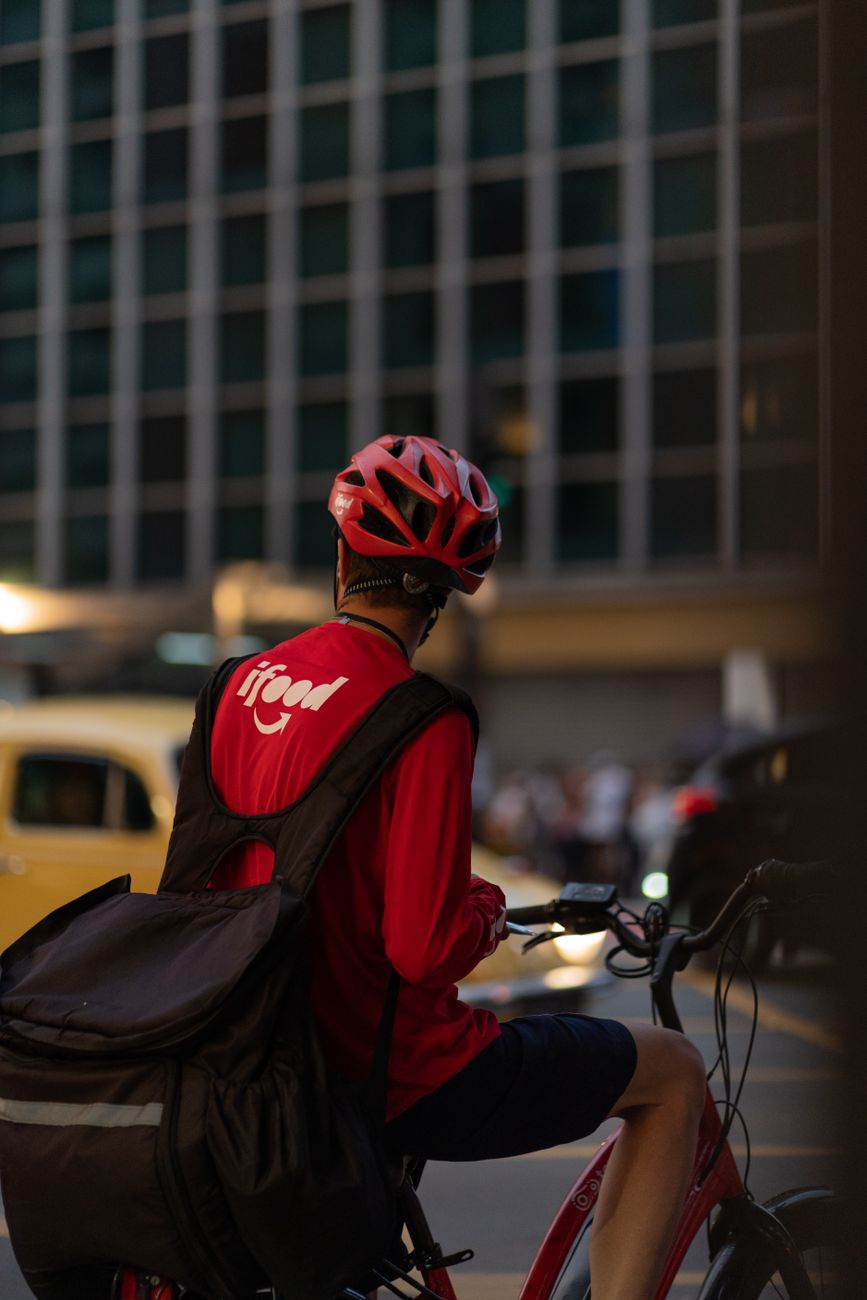
Wang Jibing was on a midnight delivery run when he got the call. He pulled over, balancing his scooter between potholes, and listened. He had won China's highest literary honor — the Mao Dun Literature Prize. The same award that went to Mo Yan before his Nobel. Wang Jibing, a food delivery rider in Shanghai, had beaten out professors, career novelists, and Beijing literati.
If that sounds like a fairy tale, you don't know China's literary underground. For the past five years, a quiet revolution has been brewing among the country's blue-collar workers. Factory hands, couriers, and construction laborers have been writing poetry and fiction in stolen moments — on lunch breaks, after 12-hour shifts, while waiting for orders. And now, one of them just won the biggest prize of all.
Verses between deliveries
Wang's winning novel, Rhapsody of the Concrete Forest, follows a delivery rider through the canyons of Shanghai. It's a picaresque of the gig economy — the traffic jams, the irate customers, the elevator that's always broken. But it's also a meditation on dignity. One passage describes the narrator's realization: 'The city sees me only as a blur on a scooter. But I see every crack in its pavement, every bruised leaf on its trees. I am its secret cartographer.'
The book took him three years to write. He composed it on his phone, using voice-to-text between orders. 'I'd dictate a paragraph at a red light,' he told a local paper. 'Sometimes I'd forget my route because I was thinking about a sentence.' Critics have compared his style to the gritty realism of Yu Hua and the lyricism of Li Bai. But Wang says his only influence is pavement: 'The road teaches you rhythm. Every pothole is a punctuation mark.'
'The city sees me only as a blur on a scooter. But I see every crack in its pavement, every bruised leaf on its trees. I am its secret cartographer.'
The blue-collar literary boom
Wang is not an outlier. In 2024, a 54-year-old security guard named Chen Nianxi published a poetry collection that sold 50,000 copies in its first month. A factory worker surnamed Zhang has a viral WeChat account where she posts poems about assembly lines. These writers share a common thread: they write about labor without romanticizing it. They don't turn factories into metaphors. They describe the heat, the monotony, the small humiliations.
It's a direct reaction to the glossy, consumerist literature that dominated Chinese bestseller lists for a decade — novels about wealthy ex-pats in Paris, or startup founders in Shenzhen. Readers are hungry for something real. 'I'm tired of reading about people whose biggest problem is which wine to pair with foie gras,' one reader commented on Douban. 'I want to read about someone who has to decide between rent and medicine.'
The government has also taken notice. The Ministry of Culture launched a 'Workers' Literature' initiative in 2023, funding workshops and publishing grants for blue-collar writers. Cynics call it propaganda — a way to co-opt working-class voices. But the writers themselves seem unfazed. 'They can use my book for whatever poster they want,' Wang told me. 'As long as I get to keep writing.'
The politics of a delivery rider with a pen
Let's not be naive. Wang's win is a political statement. The Mao Dun Prize jury — a panel of Communist Party-approved academics — could have given the award to any number of safe, establishment authors. Instead, they chose a man who represents China's 13 million gig workers. In a year marked by strikes and protests over pay and conditions, the message is clear: the Party sees you, and it values your voice.
But Wang is no puppet. His novel includes a scene where a rider crashes his scooter because he's too exhausted to see straight. The customer yells at him for being late. 'Why didn't you just fly?' she screams. In the book, he answers: 'Because angels don't work for 3 yuan per delivery.' The crowd at the award ceremony gasped. Then they gave him a standing ovation.
This is the tightrope Wang walks. He can criticize the system, but only within limits. The novel never names the delivery company (it's called 'FlashRun' in the book), and it ends with the protagonist saving enough money to send his daughter to college — a hopeful note that satisfied the censors. Still, the grit remains. You can feel the writer's anger simmering under the surface, like heat from an engine after a long drive.
What this means for Chinese literature
For decades, Chinese literary fiction was dominated by two camps: the 'scar literature' writers who chronicled the Cultural Revolution, and the 'avant-garde' authors who chased Western postmodernism. Both spoke to a narrow audience. Wang's success suggests a third path: literature that is both popular and political, accessible and angry. His book has already been reprinted three times. Movie rights are being negotiated.
Other blue-collar writers are rushing to finish their manuscripts. A group of 12 delivery riders in Beijing has formed a writing collective called 'The Last Mile.' They meet every Sunday in a park, passing around a single laptop. 'We don't have time for writer's block,' one of them said. 'If I don't write a chapter this week, I'll forget it. There's always another delivery.'
Wang's prize money — about $150,000 — won't change his life much. He plans to keep delivering food until his daughter graduates from high school. 'Writing is not a way out,' he says. 'It's a way in. Into yourself, into the city, into the lives of people who are invisible until you read about them.'
He's right. The city is full of invisible people. But now, at least, one of them has a voice that cannot be ignored.