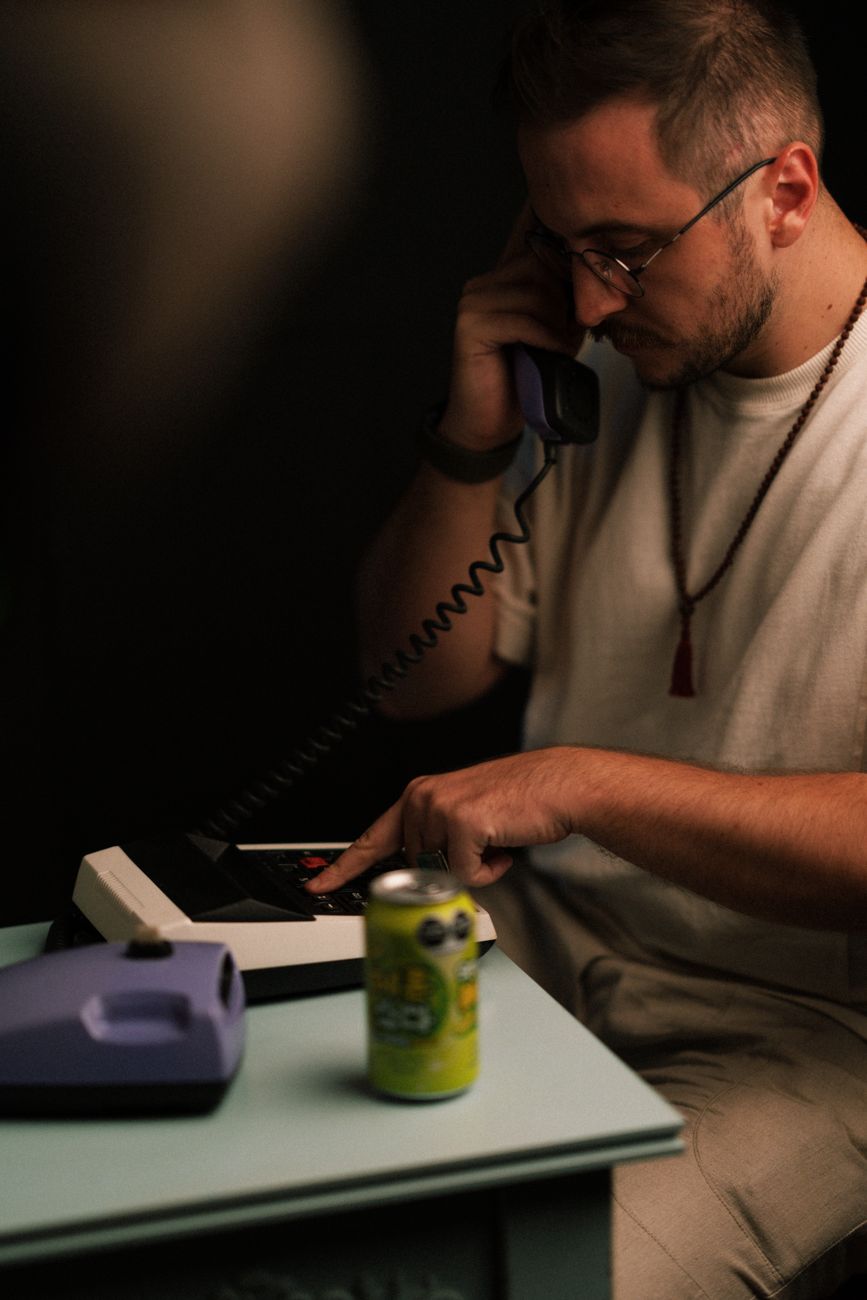
In 1983, the future of telephones looked nothing like the sleek glass slabs in our pockets today. It looked like a Commodore 64 had mated with a landline. The result was the Northern Telecom Commodore Phone — a bizarre, probably ill-conceived gadget that failed spectacularly in the marketplace. But forty years later, it feels weirdly prescient.
I got my hands on one last week. A collector in Toronto shipped it to me in a box that smelled of basement mildew and old wiring. The phone itself is a chunky beige brick with a speaker grille that looks like it was ripped from a 1980s boombox. The handset is shaped like a banana. The keypad? That's where it gets interesting.
It's a Computer. No, It's a Phone.
The Commodore Phone wasn't just a phone. It was a full-blown computer terminal. Plug it into a Commodore 64, and you could use it as a modem for BBS access — remember those? — or as a speakerphone for conference calls. The phone had a built-in 300 baud modem, which means it could transfer data at the glacial speed of 300 bits per second. To put that in perspective: downloading a single modern webpage would take about an hour.
But here's the kicker: the phone could also function as a standalone answering machine, using microcassette tapes. That was a big deal in 1983, when answering machines were still a luxury item. Northern Telecom crammed everything into one box: a phone, a modem, a speakerphone, and an answering machine. It was the Swiss Army knife of telecommunications.
And nobody bought it.
The Market Spoke, and It Wanted Simplicity
The Commodore Phone was too far ahead of its time. In 1983, most people barely understood how to use a touch-tone phone, let alone a computer-terminal hybrid. The price didn't help: $299, which is about $900 in today's money. For that, you could buy a regular phone and a separate answering machine for half the cost.
But the real problem was that it solved a problem nobody had. The internet wasn't public yet. Bulletin board systems were the domain of nerds and hobbyists. The idea of needing a modem in your phone was laughable to the average consumer. Northern Telecom bet on a future that arrived too late.
“It was a solution in search of a problem,” says tech historian Dr. Linda Park. “But that's exactly why it's fascinating now. It predicted the smartphone era, just with 1980s hardware.”
The Design: Ugly, But Functional
Let's talk about how it feels to use. The handset is heavy, with a slight curve that forces you to cradle it between your ear and shoulder. The buttons are clicky and satisfying, like a mechanical keyboard. The speakerphone mode crackles with analog warmth — you can hear the hum of 60-cycle AC power in the background. It sounds like a phone call from a movie set in 1985.
But the real joy is the modem. I connected it to a Commodore 64 I borrowed from a friend, and dialed into a Telnet BBS running on a server in someone's basement. The handshake noise — that screeching, warble-filled symphony — filled my living room. It's a sound that anyone who lived through the early internet remembers: the sound of possibility, frustration, and 300 baud.
I typed a message to the sysop: “Hello from 2026. I'm using a Commodore Phone.” He wrote back: “No way. Those things are rarer than a honest politician.”
Why It Matters Now
In 2026, we're drowning in smart devices. Our phones are computers, cameras, GPS units, and yes, telephones. Northern Telecom's vision was correct: the phone would become a computer. They just got the form factor wrong. Why build a separate terminal when you can build the computer into the phone? That's what smartphones did, and they did it twenty years later.
The Commodore Phone also foreshadowed the convergence of voice and data. We take VoIP and video calls for granted. But in 1983, the idea of sending data over the same line you used to talk was revolutionary. Northern Telecom saw that coming. They just couldn't make it work at a price people would pay.
And there's something else: the phone is a physical artifact of a time when technology was optimistic, clunky, and full of personality. Today's phones are sleek, efficient, and emotionally sterile. You don't bond with your iPhone the way you bond with a Commodore Phone. The Commodore Phone has quirks — the handset squeaks, the buttons stick, the modem overheats after twenty minutes. It's alive, in a way that modern tech rarely is.
The Verdict
The Northern Telecom Commodore Phone is a failure that deserves to be remembered. Not because it sold well — it didn't — but because it dared to imagine a future where phones were smarter than we were. It was wrong, but it was wrong in the right direction. Every time you use a smartphone, you're using a distant descendant of this beige brick. And that's worth thinking about.
I'm keeping mine. It sits on my desk, next to my modern phone. Sometimes I pick up the handset and just listen to the dial tone. It's a sound that's disappearing. The Commodore Phone reminds me that the future doesn't always arrive on schedule. But when it does, it's usually weirder than we imagined.


